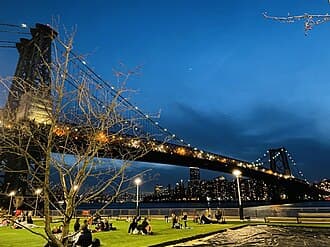

The vibe
Williamsburg is a neighborhood that already won the fight it was named for. The argument about whether it was the next cool neighborhood ended years ago. What you're walking into now is the settled version: a densely built strip of condos, boutique hotels, and walkable commercial corridors that functions less like a frontier and more like a grown-up annex of Manhattan with slightly better cocktail programs.
You'll feel that settlement in the building stock. DwellCheck's data shows the current for-sale inventory is 100% condo — there's almost no two-family, no brownstone, no rent-stabilized walkup defining the character anymore. That's the clearest signal of where Williamsburg has arrived: a market optimized for owners, not a mosaic of legacy tenants. The streetscape is uniform in a way that the rest of Brooklyn is not. You'll pass more gyms per block than you will parks.
The eastern edge, past Graham Avenue, is where the neighborhood still feels in motion. The L train rattles underneath you, the Latin American and Polish remnants of the old neighborhood still surface on certain corners, and the rent per square foot drops just enough to matter. South Williamsburg, anchored by Bedford and Division, is its own thing entirely — a Hasidic community that has its own rhythms, its own retail, and almost nothing to do with the Bedford Avenue scene to the north. Living "in Williamsburg" can mean any of those three neighborhoods.
Who actually lives here
Williamsburg, more than almost any other Brooklyn neighborhood, sorts residents by what they're optimizing for. DwellCheck's data surfaces three personas the numbers actually support:
Long-distance commuters. The commute score is 8/10, equal to the Brooklyn listing median of 8, supported by 6 subway stations — the L at Bedford, Graham, and Montrose; the G at Lorimer/Metropolitan; the M/J/Z at Marcy and Hewes. If your job is in Manhattan and you value a short ride on a train that runs frequently — 16–23 minutes to Midtown on the schedule — the math is hard to argue with.
Real estate investors and owner-occupants with cash. The investment score lands at 6.8/10, above the Brooklyn listing median of 5.8. Median for-sale price is $1.10M at $1,296/sqft, with an average days-on-market of 38. That's liquid. If you're buying a condo as a primary residence with plans to turn it into a rental within five years, the fundamentals hold up.
Practical urban renters. The practical score, which rates unit features (laundry, bedrooms, bathrooms, building age), hits 6.7/10, above the Brooklyn listing median of 6.4. Laundry is in-unit in 84% of tracked listings, bodegas and coffee shops are everywhere, and you don't need to drive, own a car, or make compromises about getting basic things done. For people who want NYC minus the hassle, Williamsburg is engineered for you.
What's worth knowing before you sign
A few practical facts that matter more than the real estate copy tells you:
The waterfront and inland blocks feel like different neighborhoods. Waterfront Williamsburg (Kent Avenue and Wythe Avenue) is glass towers, Equinox, and rooftop pools — a different cost structure and a different demographic than the blocks around Graham, where pre-war buildings, walkups, and cheaper coffee still exist. Know which Williamsburg you're renting into before you sign.
The L train is no longer the single point of failure it was. The 2019 Canarsie Tunnel shutdown scare taught residents to diversify. Today, if you're within walking distance of Marcy Avenue or Lorimer, you have multiple ways into Manhattan. That changes the risk calculus for long-term renters.
McCarren Park is the lifeline and it's not that close. Average distance to McCarren from DwellCheck's tracked listings is roughly 974 meters. Plan for that if outdoor space is non-negotiable. The Williamsburg waterfront parks (Domino, East River State) help, but they're linear strips, not full parks.
84% of tracked condos have in-unit laundry. This is unusually high for Brooklyn, where basement shared laundry is still the norm in most pre-war buildings. It's one of the quiet reasons people who move to Williamsburg stay.
💡If you're choosing a specific Williamsburg block
The L train gap between Bedford and Graham is smaller than it looks on a map: the scheduled ride to Midtown is 16 minutes from Bedford Av and 19 minutes from Graham Av (MTA subway schedule, GTFS feed of August 26, 2026; weekday midday, including the typical wait but not the walk to the station). The bigger difference is rent, which is higher near Bedford for the same unit quality. Unless you work within three blocks of Bedford, the extra cost is paying for the signage, not the commute.
The honest downsides
Williamsburg has problems it rarely admits in broker listings. They're not dealbreakers for most people, but they're real:
The tree canopy is thin. A 3.7/10 canopy density with 174 trees per 200m radius is low. In July and August you'll feel it — long stretches of Bedford, Wythe, and Kent have no real shade. The waterfront blocks are the worst offenders because the grid is newer and the street trees haven't matured.
Park access requires intention. McCarren is the only major park and it's at the north end. If you live south of Metropolitan Avenue, "going to the park" is a long walk each way. That's fine some weekends; it's a grind most Tuesday nights.
The livability score is middling. ART/livability lands at 5/10 — equal to the Brooklyn listing median of 5. Williamsburg reads as a neighborhood full of amenities but short on distinct neighborhood character. Compared to Park Slope or Carroll Gardens, it feels transactional rather than rooted.
Getting around
This is where Williamsburg actually earns its price tag. The transit stack:
- Montrose Av — L
- Metropolitan Av/Lorimer St — G L
- Graham Av — L
- Marcy Av — M J Z
- Bedford Av — L
- Hewes St — M J
From Bedford Avenue, the L is one stop to First Avenue, three to Union Square, and five to 8th Avenue/14th Street. If you work in Midtown, the J/M/Z at Marcy gets you to Essex Street in one stop, and the M continues to Bryant Park without a transfer. The G at Lorimer gets you to Long Island City, Greenpoint, and eventually Downtown Brooklyn without ever touching a Manhattan train.
Bike infrastructure on Kent Avenue and along the waterfront is genuinely usable — protected lanes, Citi Bike stations every few blocks, and a flat ride into Dumbo and Manhattan via the Williamsburg Bridge. If you're commuting into Lower Manhattan, biking is often faster than the subway door-to-door.
Check a specific Williamsburg address
DwellCheck's neighborhood data is aggregate. The full dashboard for Williamsburg — scores by dimension, crime data, 311 complaints, transit breakdowns — is free.
See Williamsburg Data Dashboard →Frequently asked questions
1Is Williamsburg a good place to live?
Williamsburg scores 5.9/10 on DwellCheck's composite livability index, #4 of 11 Brooklyn neighborhoods DwellCheck scores from for-sale listings. It's very good if you want transit access (commute score 8/10), fast access to Manhattan, and a walkable, nightlife-heavy neighborhood. It's weaker if you want trees, parks, or quiet — outdoor score is only 4.1/10 and tracked listings average 974 meters to the nearest major park (McCarren).
2What's the vibe in Williamsburg?
Williamsburg in 2026 is less "hipster" than it is "what happens after a hipster neighborhood wins." Bedford Avenue is mostly boutiques and international chains now. The L train scene is more coworking than warehouse. There's still an independent bar and venue scene, especially east of Graham Avenue, but the center of gravity has shifted toward professionals in their late twenties and thirties with steady incomes.
3How much does rent cost in Williamsburg?
Williamsburg is priced for people with serious income. The median for-sale condo is around $1.10M at $1,296/sqft, and rentals follow. DwellCheck doesn't track rents, and we don't publish rent figures we can't source; compare live listings for current asking rents. South Williamsburg and the blocks east of the Graham L are generally cheaper than waterfront towers.
4Is Williamsburg safe?
By DwellCheck's count Williamsburg has a lower crime rate per resident than 42% of Brooklyn neighborhoods, with 3,619 reported crimes (NYPD complaint data, 12 months to June 30, 2026). Common issues include noise, package theft, and bike crime. Like most of NYC, safety is block-by-block. Use DwellCheck on a specific address to see NYPD crime within 300m and 311 noise complaints within 100m.
5Is Williamsburg good for young professionals?
Yes — it's arguably the quintessential young-professional Brooklyn neighborhood. The scheduled subway ride to Midtown is 16–23 minutes from Williamsburg's stations (MTA subway schedule, GTFS feed of August 26, 2026; weekday midday, including the typical wait but not the walk to the station), the M/J/Z at Marcy give you a second path into Manhattan, and the bar/restaurant density is high. It's less ideal if you want quiet, a yard, or a lot of green space.
6Is Williamsburg good for families?
It's workable but not obvious. The practical score (6.7/10, above the Brooklyn listing median of 6.4) reflects unit features such as in-unit laundry, not errands, though groceries and services are easy to reach. But the outdoor score (4.1) and limited park access mean families typically gravitate to the McCarren Park side or cross over to Park Slope or Fort Greene. If you want strollers and storytime, Park Slope is still the obvious choice.
7What's the best part of Williamsburg?
The transit stack. 6 subway stations — Bedford, Graham, Lorimer/Metropolitan, Montrose, Marcy, and Hewes — cover the L, G, J, M, and Z. You can get to Manhattan, downtown Brooklyn, and Queens without a transfer from at least one of them. For a lot of residents, that's the entire thesis.
8What's the worst part of Williamsburg?
The green space gap. With an average of only 174 trees within 200 meters and a canopy density of 3.7/10, you notice the lack of shade in July. McCarren Park is great but not close to most of the neighborhood. If you need a daily green fix, Williamsburg will feel dry.
9How is the commute from Williamsburg to Manhattan?
Fast for most of the neighborhood. Scheduled subway time is 16–23 minutes to Midtown and 15–25 minutes to the Financial District from Williamsburg's stations (MTA subway schedule, GTFS feed of August 26, 2026; weekday midday, including the typical wait but not the walk to the station); the L from Bedford is the quickest into Manhattan. The M and J at Marcy reach Delancey/Essex in one stop. The G at Metropolitan is your transfer to Queens and the rest of Brooklyn. Overall commute score is 8/10, equal to the Brooklyn listing median of 8.
10What's the food scene in Williamsburg?
Dense and uneven. The waterfront side has the Instagram-famous restaurants and the hotels' rooftop bars. The Bedford corridor is where most of the coffee, bagels, and second-wave natural wine bars live. Graham Avenue still has holdovers from the older Italian neighborhood. South Williamsburg has Latin American taquerias and one of the city's best concentrations of kosher bakeries and delis near the Hasidic quarter.
11Is Williamsburg gentrifying?
Williamsburg has essentially completed its gentrification cycle. The 100% condo share of current for-sale inventory says everything: the neighborhood has converted from mixed-use industrial and longtime tenant stock into an investor-grade condo market. What's still changing is the eastern and southern edges, where older housing and small commercial still exist.
12Is Williamsburg worth it?
If you need fast transit, want a walkable bar/restaurant scene, and can absorb Manhattan-adjacent prices, yes. If you want trees, affordability, and quiet, go to Sunnyside, Kensington, or deeper into Brooklyn. Williamsburg is priced as a premium convenience product now, not a discovery.
The bottom line
Williamsburg in 2026 is a confident, expensive, transit-first neighborhood that has stopped selling itself and started operating like infrastructure. If you want fast access to Manhattan, a walkable bar and restaurant scene, and a condo market with real liquidity, it delivers. If you want trees, quiet, or a neighborhood still figuring out what it wants to be, you're a few stops too west — Bushwick, Ridgewood, and even Sunnyside are closer to that energy now. DwellCheck's composite of 5.9/10 is above the Brooklyn listing median of 5.5: good at commute, not the best version of anything else.