
The vibe
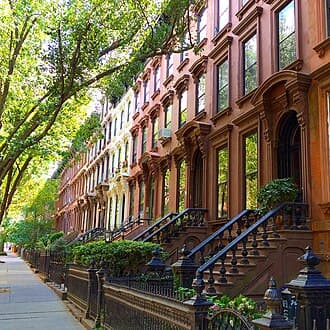
Park Slope is what happens when a neighborhood gets it right and then stops. Fifth Avenue has the wine bars and the independent bookshop that refuses to close. Seventh Avenue has the bagel place, the hardware store, and the pediatricians. The side streets are brownstones — real ones, original stoops, ironwork, some restored within an inch of their lives and some still lived in by the families who bought them generations ago. The whole neighborhood has the slightly unreal quality of a New York that was supposed to disappear but never quite did.
The tree canopy tells the story. DwellCheck's data shows 232 trees within 200 meters of the average tracked building and a canopy density of 7.5/10 (the listings' average). On a summer afternoon, you'll actually walk in shade. Combined with Prospect Park — designed by Olmsted and Vaux as a more ambitious follow-up to Central Park — and the Brooklyn Botanic Garden adjacent, few densely built NYC neighborhoods match Park Slope's green-space access.
The catch is that the neighborhood knows all of this, and the price tag reflects it. DwellCheck's financial score for Park Slope comes in at 4.9/10 — below the Brooklyn listing median of 5.7. The ART/livability score is 7/10, above the Brooklyn listing median of 5. You're paying for character and proximity, not for upside or value. That split defines the experience of living here: it's excellent, and it's expensive, and the two facts are directly related.
Who actually lives here
Park Slope has a stronger central archetype than most NYC neighborhoods, but DwellCheck's data surfaces three subtler subtypes:
Commuters who also want a neighborhood. The commute score is 8.4/10, above the Brooklyn listing median of 8. 8 subway stations serve Park Slope directly, including Atlantic Avenue/Barclays which connects the 2, 3, 4, 5, B, D, N, Q, and R in a single hub. You can live here, work in Midtown, and still get home at 7pm to walk in the park. That combination is almost impossible anywhere else at this density.
Arts and culture residents. The ART/livability score of 7/10 is above the Brooklyn listing median of 5. Between the Brooklyn Academy of Music, the Brooklyn Museum, Prospect Park's summer concerts, Union Hall, and a still-surprising number of independent bookstores and small theaters, there's more cultural density here than the family-neighborhood reputation suggests. The people filling those seats are often Park Slope residents who moved here for quiet but stayed for the programming.
Outdoor-oriented buyers with real budgets. The outdoor score of 5.3/10 is above the Brooklyn listing median of 4.6 but below what you'd expect from a park-adjacent neighborhood. That's because park access isn't uniform — the blocks closest to Prospect Park are different living than the blocks west of 5th Avenue. Buyers who prioritize the green space should expect to pay a meaningful premium for the east-side blocks.
What's worth knowing before you sign
North Slope and South Slope are different neighborhoods. North Slope runs roughly from Flatbush to 9th Street, has the higher-end restaurants and the brownstone row houses that end up in magazine features. South Slope, from 9th down to Prospect Avenue, is meaningfully cheaper, more working-family-feeling, and has more walkups and smaller condo buildings. A one-bedroom in South Slope usually rents for noticeably less than the same unit in North Slope.
Prospect Park is the back yard, but it's also an event venue. Summer brings the annual concert series to the bandshell, Smorgasburg, road races, and a constant flow of weekend crowds. Living directly on the park gets you the view and the noise. Most residents agree it's worth it; a few regret it every July.
The Park Slope Food Coop is a genuine institution. It's one of the best-known member-owned food coops in the country, requires members to work a regular shift, and uses that labor to keep prices low. It's a running joke in the rest of the city and a practical reason some families specifically move here.
School District 15 is a major part of the price. Families pay a premium on comparable units because the public elementary and middle schools are among the city's most desired. If you don't have kids or don't plan to, you're paying for a school district you won't use.
💡If you're deciding between Park Slope blocks
The blocks between 7th Avenue and Prospect Park West are the most expensive in the neighborhood. 5th Avenue is the commercial spine and costs slightly less. 4th Avenue is a busy traffic corridor — cheaper, noisier, and often the best value if you tolerate the volume. West of 4th, you're functionally in Gowanus, with a different price floor and feel.
The honest downsides
The cost of entry is brutal. A $1.45M median isn't aspirational — it's the midpoint. The bottom quartile of for-sale inventory starts near $900k. Rentals are priced to match. If you're buying, you're committing capital that would stretch further almost anywhere else in Brooklyn.
The neighborhood can feel insulated. Park Slope has a well-earned reputation for being a bit of a bubble — residents who stay for decades, kids who grow up inside the same few blocks, a social scene that can feel closed to newcomers in their thirties without young kids. It's not hostile, but it's not the kind of neighborhood where you meet your next best friend at the corner bar.
Investment metrics are soft. Investment score is 5.4/10, below the Brooklyn listing median of 5.8. Average days on market is 62 — not distressed, but slower than hotter neighborhoods. If you're buying as a long-term residence, fine. If you're buying for appreciation, Park Slope is a weaker bet than Bushwick or the Bed-Stuy border.
Getting around
Transit options from inside the neighborhood:
- Union St — R
- Bergen St — 2 3
- 7 Av — B Q, F G
- Grand Army Plaza — 2 3
- Prospect Av — R
- 4 Av-9 St — F G R
- 15 St-Prospect Park — F G
- Atlantic Av-Barclays Ctr — 2 3 4 5 B D N Q R
The R at Union Street and Prospect Avenue is the local workhorse: slow to Manhattan but reliable. The 2/3 at Bergen Street and Grand Army Plaza is the express pair. Scheduled subway time to Midtown is 21–33 minutes from Park Slope's stations (MTA subway schedule, GTFS feed of August 26, 2026; weekday midday, including the typical wait but not the walk to the station). The F/G at 7th Avenue and 4th Avenue/9th Street is the cross-Brooklyn option: the G connects to Long Island City and points north, the F runs express into Midtown. And Atlantic Avenue/Barclays gives you the entire Brooklyn trunk in a single station — the B, D, N, Q, and R, plus the 2, 3, 4, and 5. It's one of the best-connected residential nodes in the outer boroughs.
For biking, Prospect Park West has a protected bike lane, and the park itself is closed to cars during most hours, which makes it a favorite commuter route into downtown Brooklyn.
Check a specific Park Slope address
DwellCheck's neighborhood data is aggregate. The full Park Slope data dashboard — dimension scores, crime maps, 311 complaints, building-level data — is free.
See Park Slope Data Dashboard →Frequently asked questions
1Is Park Slope a good place to live?
Park Slope scores 5.5/10 on DwellCheck's composite index (equal to the Brooklyn listing median of 5.5), with standout ART/livability (7/10, above the Brooklyn listing median of 5) and solid transit (8.4/10 commute). It's excellent if you can afford the $1.45M median entry and want tree-lined streets, Prospect Park access, and a grounded residential feel. The financial score (4.9/10, below the Brooklyn listing median of 5.7) is the weakness: you're paying for character, not a bargain.
2What's the vibe in Park Slope?
Park Slope is the anti-Williamsburg. Where Williamsburg sells vibe, Park Slope just has one. It's a Brooklyn residential neighborhood in the literal sense: brownstones, old trees, playgrounds, the kind of corner bookstore that still exists, and a Fifth Avenue that's somehow still mostly local. Yes, the strollers are real, but the cliché misses that it's also one of the last neighborhoods where a young couple, a retired professor, and a family with a fifteen-year-old can all feel equally in place.
3How much does rent cost in Park Slope?
Park Slope is Brooklyn's upper tier. Median for-sale price is $1.45M at $1,362/sqft. DwellCheck doesn't track rents, and we don't publish rent figures we can't source; compare live listings for the blocks you're considering. North Slope (closer to Grand Army Plaza) is generally the most expensive; South Slope near 15th Street is cheaper.
4Is Park Slope safe?
By DwellCheck's count Park Slope has a lower crime rate per resident than 47% of Brooklyn neighborhoods, with 2,806 reported crimes (NYPD complaint data, 12 months to June 30, 2026). Common concerns are package theft, car break-ins, and issues around the park at night. As always, safety varies block-by-block — DwellCheck's address-level reports give you walking-radius crime data for any specific building.
5Is Park Slope good for families?
Park Slope is the prototype family neighborhood in Brooklyn. Prospect Park is the back yard. The public schools in District 15 are among the most sought-after in the city. There are playgrounds, pediatricians, children's bookstores, and a food co-op all within a few blocks. The trade-off is cost — families without equity or dual income find it hard to stay past the second kid.
6Is Park Slope good for young professionals?
It works, but it's not the obvious pick. Young professionals without kids usually gravitate toward the bar and restaurant density of Williamsburg, Fort Greene, or Crown Heights. Park Slope has those amenities but dials them down — the neighborhood goes quiet earlier and skews older. If you want a calm residential life with the park nearby, it's a great fit. If you want to go out four nights a week, you'll end up commuting to other neighborhoods.
7What's the best part of Park Slope?
Prospect Park. Nothing else is close. Long Meadow, the Lullwater, the Ravine, Nethermead — plus the Brooklyn Botanic Garden and the Brooklyn Museum adjacent. Combined with a tree canopy density of 7.5/10 and an average of 232 trees per 200m on residential blocks, you get a genuinely green urban experience. That's the entire thesis of the neighborhood.
8What's the worst part of Park Slope?
The price-to-value math on buying. The financial score (4.9/10) is below the Brooklyn listing median of 5.7, which means you're paying a premium for an established neighborhood with limited upside. Average days on market is 62 days — slower than hotter neighborhoods. If you're buying as an investment, the numbers work better elsewhere. If you're buying as a place to live for twenty years, they work fine.
9How is the commute from Park Slope to Manhattan?
Strong. Commute score is 8.4/10, above the Brooklyn listing median of 8. You have the R train at Union and Prospect, the 2/3 at Bergen and Grand Army Plaza, the B/Q/F/G at 7th Avenue, and — the real advantage — Atlantic Avenue/Barclays Center at the northern edge, which gives you the 2, 3, 4, 5, B, D, N, Q, and R all in one stop. Scheduled subway time is 21–33 minutes to Midtown and 10–22 minutes to the Financial District from Park Slope's stations (MTA subway schedule, GTFS feed of August 26, 2026; weekday midday, including the typical wait but not the walk to the station); add the walk to the station.
10What's the food scene in Park Slope?
Grounded rather than trend-chasing. Fifth Avenue between Union and 9th Street is the main strip — wine bars, a few old-school Italian spots, neighborhood restaurants that have been there for years, brunch places you can actually get into. Seventh Avenue is more about bakeries, bagels, and coffee. It's not the Michelin scene of Williamsburg or the experimental energy of Bed-Stuy, but the quality floor is high.
11Is Park Slope gentrifying?
Park Slope finished gentrifying decades ago. The current conversation is different: whether the next generation of families can afford to stay. The 88% condo / 7% two-family / 5% townhouse split in DwellCheck's for-sale data reflects a fully established market. What's changing now is churn — longtime owners selling to buyers with tech or finance incomes who price out the professional-class families who defined the neighborhood in the 1990s and 2000s.
12Is Park Slope worth it?
If you can afford the $1.45M median and you value quiet, trees, and a real park, yes — it's one of the most livable neighborhoods in the city. DwellCheck's ART/livability score of 7 vs. the Brooklyn listing median of 5 is not an accident. If you're priced out or you want a more energetic scene, look at Prospect Heights or Windsor Terrace for similar feels at lower entry points.
The bottom line
Park Slope scores 5.5/10 on DwellCheck (#9 of 11 Brooklyn neighborhoods scored from for-sale listings). The split is the entire story: strong ART/livability and transit, weaker financials and investment metrics. That's what you're buying into. If you want a neighborhood that feels like a real place to live for the next twenty years, and you can afford the $1.45M median, there are few better options in the city. If you want the neighborhood everyone else is buying into first, you're about a decade late.