
The vibe
Bushwick is the neighborhood that finished being cool and started being a place where people actually live. The loft parties and the warehouse venues that defined the 2010s are mostly gone — the buildings got bought, the owners cashed out, and the spaces became condos or closed outright. What's left is more honest: a genuinely mixed neighborhood where a longstanding Puerto Rican and Dominican community still anchors the commercial corridors, the artists who held on still have studios in the remaining industrial edges, and newer residents have settled into the condo buildings clustered around the L train.
DwellCheck's data captures the trade-offs clearly. The financial score of 8.4/10 is above the Brooklyn listing median of 5.7 — meaning Bushwick still represents real value relative to surrounding neighborhoods at $786/sqft. At the same time, the ART/livability score is 4.2/10, below the Brooklyn listing median of 5. That gap is the neighborhood's current paradox: the price signals you're moving somewhere exciting, but the structural measures of cultural density don't fully back it up anymore. The creative scene is still there, but it's quieter and more dispersed than it used to be.
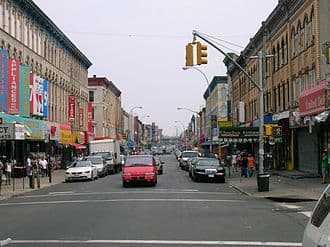
The streetscape reflects that. You'll walk past a fully renovated condo with a concierge, then a tire shop that's been there for decades, then a coffee shop serving oat milk flat whites, then a bodega with hand-painted signage. 56% of the tracked for-sale stock is condo, 39% is two-family homes, and 5% is townhouses. That mix is the key — Bushwick has not become uniform the way Williamsburg has. It's still genuinely layered.
Bushwick vs. Williamsburg
Williamsburg (by way of East Williamsburg) is Bushwick's neighbor to the northwest. Among the for-sale listings DwellCheck scored, Bushwick averaged $786/sqft and Williamsburg $1,296/sqft; Williamsburg's commute score is 8/10 against Bushwick's 6.3/10, and the overall scores are 6.2/10 for Bushwick and 5.9/10 for Williamsburg. In practice Bushwick is the cheaper, rougher-edged neighbor with the weaker commute score.
Who actually lives here
Bushwick's resident mix reflects a neighborhood in active transition. DwellCheck's data supports three personas for the current moment:
Financially-oriented buyers. The financial score of 8.4/10 is above the Brooklyn listing median of 5.7. You're getting bigger units for your money than nearly anywhere else in north-central Brooklyn, and the fundamentals (access, demand, long-term appreciation story) still hold. Buyers who can see past the lingering rough edges are getting real value.
Practical car-independent renters. 7 subway stations on the J, L, M, Z lines serve the neighborhood, and most daily amenities are walkable, though the stations are scattered. If you can choose your block carefully to be a short walk from a station you actually want, the neighborhood works well without a car.
Long-term buyers with patience. Investment score is 6/10, and the average days on market is 132 — slower than hotter neighborhoods. That's a feature if you're a patient buyer. It means less competition and more room to negotiate, in exchange for accepting that your appreciation story will unfold over years, not months.
What's worth knowing before you sign
Pick your station before you pick your apartment. This matters more in Bushwick than in most neighborhoods. The L at Jefferson is a different commute than the M at Central Avenue, which is a different commute than the J at Kosciuszko. The scheduled ride to Midtown alone ranges 25–33 minutes across Bushwick's stations (MTA subway schedule, GTFS feed of August 26, 2026; weekday midday, including the typical wait but not the walk to the station). Always map the walk before signing.
The "artistic Bushwick" narrative is uneven. DwellCheck's ART/livability score of 4.2/10 is below the Brooklyn listing median of 5, a data signal that the density of cultural venues, galleries, and active creative infrastructure is not as high as the marketing suggests. There's still a real scene — Bushwick Open Studios, a handful of galleries on Troutman and Bogart, and active studios in the industrial blocks — but it's concentrated, not everywhere.
Park access is a real weakness. DwellCheck's tracked Bushwick listings average 4.1 km to their nearest major park, McCarren — not walkable. Maria Hernandez Park and Irving Square Park are the local options, and they're fine for a quick break but limited for people who want real green space.
The tree canopy is thin but growing. 168 trees per 200m and a canopy density of 4.8/10 (the listings' average) is modest. The city's been planting in Bushwick, particularly on the residential side streets. Many blocks are still bare; a few are starting to feel shaded.
💡If you're choosing a Bushwick block
The rule of thumb: blocks near Jefferson L, Morgan L, or Myrtle-Wyckoff L/M are the most expensive in Bushwick. Blocks off the M at Central or Knickerbocker are a real discount and still walkable to the same bars and restaurants. Blocks east of Irving Avenue or south of Gates are the true value plays but add commute time and require more due diligence on crime and street feel.
The honest downsides
The commute is less reliable than the station count suggests. A 6.3/10 commute score in a neighborhood with 7 stations tells you that the stations don't evenly serve the residential blocks. Long walks are common. The L train has chronic reliability issues. The M train shuts down for weekend work frequently. The J is quirky enough that most residents don't default to it.
Gentrification friction is real. Bushwick is one of the neighborhoods where the tension between long-term residents and newer ones is most visible. New condo buildings next to older walkups create obvious economic contrasts. If you're moving here, being aware of that dynamic is part of living in the neighborhood well.
The for-sale market is slow. 132 days on market means if you're buying, you have negotiating power, but if you need to sell in a few years, expect a softer market than hotter Brooklyn neighborhoods. Plan your hold accordingly.
Getting around
Transit options from Bushwick:
- Halsey St — J, L
- Kosciuszko St — J
- Central Av — M
- Myrtle Av — M J Z
- Gates Av — J Z
- Myrtle-Wyckoff Avs — M L
- Jefferson St — L
The L train at Jefferson, Morgan, and Myrtle-Wyckoff is the flagship service — direct to Manhattan, frequent during rush hours, chronically unreliable on nights and weekends. The M at Central, Myrtle, and Myrtle-Wyckoff is the Midtown option: slower but direct to 6th Avenue. The J at Kosciuszko and Gates, and the Z at Gates, run elevated to Delancey/Essex and are the fastest route to lower Manhattan if you work downtown.
Bike infrastructure in Bushwick is improving — the Wyckoff Avenue and Myrtle Avenue corridors have lanes, and there are Citi Bike stations clustered near the L stops. For a lot of residents, the bike is the secret-weapon option for reaching Williamsburg or crossing into Queens without waiting for a train.
Check a specific Bushwick address
DwellCheck's neighborhood data is aggregate. The full Bushwick data dashboard — dimension scores, crime heatmaps, 311 complaints, building-level data — is free.
See Bushwick Data Dashboard →Frequently asked questions
1Where is Bushwick?
Bushwick is a neighborhood in northern Brooklyn, New York City, covered by Brooklyn Community Board 4. It borders Ridgewood, Queens, to the northeast, East Williamsburg to the northwest, Bedford-Stuyvesant to the southwest along Broadway, and Cypress Hills and East New York to the southeast. It is served by 7 subway stations on the J, L, M, Z lines.
2How far is Bushwick from Manhattan?
By subway, the scheduled ride from Bushwick's stations is 25–33 minutes to Midtown and 20–32 minutes to the Financial District (MTA subway schedule, GTFS feed of August 26, 2026; weekday midday, including the typical wait but not the walk to the station). The L runs across 14th Street, the M reaches Midtown on Sixth Avenue, and the J and Z run to Delancey/Essex and lower Manhattan.
3What's the difference between Bushwick and Williamsburg?
Williamsburg (by way of East Williamsburg) is Bushwick's neighbor to the northwest. Among the for-sale listings DwellCheck scored, Bushwick averaged $786/sqft and Williamsburg $1,296/sqft; Williamsburg's commute score is 8/10 against Bushwick's 6.3/10, and the overall scores are 6.2/10 for Bushwick and 5.9/10 for Williamsburg. In practice Bushwick is the cheaper, rougher-edged neighbor with the weaker commute score.
4Is Bushwick a good place to live?
Bushwick scores 6.2/10 on DwellCheck's composite index, above the Brooklyn listing median of 5.5 (DwellCheck scores Bushwick from for-sale listings). It's an excellent choice if you want a lower cost of entry than Williamsburg, a still-active art scene, and a neighborhood that hasn't fully settled into its final form. The weaknesses are fragmented transit (commute score 6.3/10, below the Brooklyn listing median of 8) and an ART/livability score (4.2/10, below the Brooklyn listing median of 5) that's surprisingly low given the neighborhood's reputation.
5What's the vibe in Bushwick?
Bushwick in 2026 is a neighborhood mid-negotiation. The warehouse-party era is mostly over — most of those spaces are either closed, turned into condos, or pivoted to brunch. What's left is a layered place: the original Hispanic neighborhood that's been here for decades, the artists who moved in during the late 2000s, and the newer residents who came for the cheaper-than-Williamsburg rent. You feel all three at once depending on which block you're on.
6How much does rent cost in Bushwick?
DwellCheck doesn't track rents, and we don't publish rent figures we can't source. What we do have is the for-sale side: the median price of the listings DwellCheck scored in Bushwick is $1.05M at $786/sqft. Rents generally run higher near the Myrtle-Wyckoff and Jefferson L stops than further east toward Halsey and Broadway Junction; compare live listings for the blocks you're considering.
7What should I know about safety in Bushwick?
Bushwick's safety is block-by-block in a way that matters more here than in more homogenous neighborhoods. The blocks around Maria Hernandez Park and near Myrtle-Wyckoff have seen serious investment; the blocks further east along Broadway or around Halsey are more variable. By DwellCheck's count Bushwick has a lower crime rate per resident than 28% of Brooklyn neighborhoods (NYPD complaint data, 12 months to June 30, 2026). The Bushwick neighborhood page on DwellCheck has the full crime numbers; for a specific apartment, check its address for NYPD crime within 300m.
8Is Bushwick good for young professionals?
Yes — it's become the default next-step Brooklyn neighborhood for young professionals priced out of Williamsburg. You get most of the bar and restaurant scene, the L train for a direct Manhattan connection, and lower rents on bigger units. The trade-offs are commute reliability (the L has issues), a lower crime rate per resident than 28% of Brooklyn neighborhoods (NYPD complaint data, 12 months to June 30, 2026), and less polished infrastructure.
9Is Bushwick good for families?
It's becoming more viable but it's not Park Slope. Schools are variable, parks are limited (DwellCheck's tracked listings average 4.1 km to their nearest major park, McCarren), and the streetscape can feel rough in spots. That said, there's a real contingent of families in the blocks near Maria Hernandez Park and in the 2-family homes that make up 39% of the tracked for-sale stock. If you're buying and plan to stay through grade school, the math can work.
10What's the best part of Bushwick?
The price-to-access ratio is still the best thing about it. Financial score of 8.4/10 — above the Brooklyn listing median of 5.7 — reflects real value relative to the rest of the borough. You're getting L train access, most of the Williamsburg food scene, and serious square footage for meaningfully less than you'd pay one subway stop west. That's a rare combination.
11What's the worst part of Bushwick?
The transit is fragmented in a way that surprises people. 7 subway stations sounds like a lot, but they're scattered across the J, L, M, Z lines and many sit a long walk from residential blocks. The practical effect: your commute quality depends heavily on which specific block you land on. The 132-day average days-on-market also suggests the for-sale market is softer and slower than broker listings imply.
12How is the commute from Bushwick to Manhattan?
Depends entirely on which station you're closest to. The L at Jefferson or Halsey runs straight across 14th Street. The M via Central Avenue or Myrtle Avenue reaches Midtown on Sixth Avenue without a transfer. The J at Kosciuszko or Gates is an elevated ride into Delancey/Essex that's underrated if you work in lower Manhattan. Scheduled subway time is 25–33 minutes to Midtown and 20–32 minutes to the Financial District from Bushwick's stations (MTA subway schedule, GTFS feed of August 26, 2026; weekday midday, including the typical wait but not the walk to the station). Overall commute score is 6.3/10.
13What's the food scene in Bushwick?
Layered, diverse, and still evolving. The Latin American food — particularly Mexican and Puerto Rican — is the historical base and has some of the best taquerias in North Brooklyn. Over the last decade, a second wave of pizza places, natural-wine bars, and coffee shops has moved in, mostly clustered around Knickerbocker and along Wyckoff. Roberta's and Ops are the marquee names; the neighborhood has genuine depth beyond them.
14Is Bushwick gentrifying?
Bushwick has been gentrifying since the late 2000s and it's not done. The current phase is the consolidation phase: the pioneer artists mostly left when their lofts turned into condos, the second wave of young professionals now fills the newer buildings, and the original neighborhood is still partially intact on blocks that haven't been bought up. DwellCheck's data shows the financial score (8.4/10) is strong, which in this context reads as "still cheaper than surrounding areas, which means still attractive to capital."
15Is Bushwick worth it?
If you want the best remaining value in North Brooklyn and you can tolerate fragmented transit and a neighborhood still in flux, yes. You get better square footage for your money than Williamsburg or Park Slope. If you want polished streets, strong schools, or Prospect Park access, look at Prospect Lefferts Gardens or Crown Heights instead. Bushwick is a neighborhood for people who want NYC without the final polish.
The bottom line
Bushwick scores 6.2/10 on DwellCheck — above the Brooklyn listing median of 5.5, with a financial score above the Brooklyn listing median of 5.7 and commute and ART/livability scores below theirs. It's the best remaining value play in North Brooklyn, but it's not for everyone. If you want a fully polished neighborhood, cross the border into Williamsburg and pay the premium. If you can accept a neighborhood that still has rough edges in exchange for real square footage, a real art and food scene (if quieter than it used to be), and a serious cost advantage, Bushwick remains one of the more honest choices in Brooklyn.