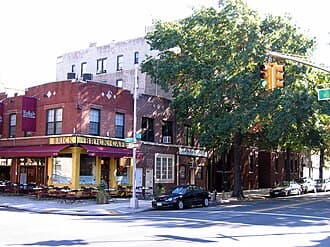

The vibe
Astoria is the answer to the question "what if a neighborhood could gentrify without pretending to." You walk down 30th Avenue and you pass the natural-wine bar that opened last year, then the Greek bakery that's been there since the 1960s, then a butcher shop with the Brazilian flag in the window, then a Middle Eastern pastry counter, then a coffee shop with a third-wave roaster's logo. They all have customers. That coexistence is the neighborhood's defining feature, and it's rarer in NYC than it used to be.
Trees are not the draw. DwellCheck's tree density for Astoria is 3.1/10, on the sparse side for the city, with an average of 137 trees per 200m in NYC Parks' tree inventory. What shade there is clusters on the residential side streets between 30th Avenue and Astoria Park.
DwellCheck's practical score of 8/10 measures HPD housing violations per residential lot; it is equal to the Queens median of 8. Day-to-day logistics are smooth for a different reason: groceries, pharmacies, laundromats, gyms, coffee shops, bars, hardware stores — they're all within a few blocks of wherever you end up. Astoria is a neighborhood that works when the phone is dead and you need to run a handful of errands on foot.
Who actually lives here
Astoria has one of the most demographically interesting resident mixes in the city. DwellCheck's data supports three broad personas:
Practical-minded renters. The practical score of 8/10 is equal to the Queens median of 8. If your priority is a neighborhood that just works — reliable grocery stores, coffee shops on every corner, a laundromat within two blocks — Astoria delivers consistently. This is the quiet reason a lot of 30-somethings end up here and don't move for a decade.
Commuters accepting longer trips. The commute score of 7/10 (above the Queens median of 3.5) counts the stations and lines inside Astoria; it doesn't measure travel time. The scheduled N/W ride to Midtown is 20–24 minutes from Astoria's stations (MTA subway schedule, GTFS feed of August 26, 2026; weekday midday, including the typical wait but not the walk to the station). People who move here have decided that the quality of daily life is worth a longer trip than a Manhattan or LIC address.
Arts and culture seekers. DwellCheck's ART/livability score (2.6/10, below the Queens median of 4.1) measures tree density and noise complaints, not culture. The culture is real anyway: between the Museum of the Moving Image, the Kaufman Astoria Studios campus, Socrates Sculpture Park, Astoria Park's summer programming, and an unusual density of independent theaters and galleries, there's a real cultural layer here that the Greek food headlines tend to obscure.
What's worth knowing before you sign
"Astoria" covers a lot of ground. The blocks around 30th Avenue and Broadway are the heart of the commercial scene and the most gentrified. Ditmars, to the north, is quieter and more residential — the families and longtime Greek residents concentrate here. East of 31st Street, you start getting into denser walkup territory with lower rents. West toward Steinway, the vibe shifts more industrial and more Middle Eastern and North African. Where you land within Astoria matters almost as much as choosing Astoria.
Walkups and two-family houses dominate the building stock. Of Astoria's 11,696 residential tax lots in NYC City Planning's PLUTO, 38% are two-family houses, 37% walk-up apartment buildings and only 2% elevator apartment buildings. That means if you want an elevator, a doorman, or in-unit laundry in a newer building, you're shopping in a small slice of the stock and paying a premium for it. If you're fine with a walkup, your options open up significantly and rents drop.
Astoria Park is the quiet jewel. Most visitors don't know about it. It has a WPA-era public pool and sits on the East River with a clear view of the Hell Gate Bridge. For residents in the blocks around Ditmars and 21st Street, it's a real daily amenity.
You don't need a car. Astoria is one of the few outer-Queens neighborhoods where car-free living is not a compromise. Groceries, services, nightlife, and transit are all walkable from most blocks. Zipcar and Citi Bike fill in the gaps.
💡If you're choosing an Astoria block
The trade-off is clear. Blocks close to the 30th Avenue N/W station are the most walkable and the most expensive. Blocks closer to Ditmars-Astoria Boulevard give you quieter streets and Astoria Park access but a longer walk to the train. Blocks east of 31st Street are cheaper but further from transit. Astoria is one of the few neighborhoods where the commercial corridor and the quiet residential core are both worth picking, depending on what you want your daily life to feel like.
The honest downsides
The commute is the real cost. Astoria's commute score (7/10, above the Queens median of 3.5) rewards its several N/W stations, but it is one line with no redundancy: the scheduled ride is 20–24 minutes to Midtown and 31–35 minutes to the Financial District before the walk, with real variability when the BMT Broadway line has issues. Factor the time into the rent math if your time is valuable.
Noise is block by block. Per resident, Astoria's 311 noise complaints are moderate among the NYC neighborhoods DwellCheck tracks, but the neighborhood is dense and active — shisha bars, outdoor cafes, late-night restaurants, and the elevated N/W over 31st Street all contribute. Blocks next to 31st Street or the elevated tracks will be louder than the neighborhood figure suggests. Always check noise on a specific address before signing.
Outdoor space is mostly small parks. Astoria Park is excellent; most of the other 20 NYC Parks properties inside the neighborhood are playgrounds and ball fields, not destinations. The outdoor score is 6.2/10, above the Queens median of 6.
Getting around
Transit from Astoria:
- Astoria-Ditmars Blvd — N, W
- Astoria Blvd — N, W
- 30 Av — N, W
- Broadway — N, W
- Additional N/W stops — 36th Avenue and 39th Avenue, further south on the same line, are outside the area DwellCheck measures for Astoria.
- M60 SBS bus — connects to 125th Street/Harlem and LaGuardia Airport. A useful alternative for upper Manhattan destinations.
The N and W are the only subway options, which is the structural weakness of Astoria transit: there's no redundancy. When the line has a problem, the neighborhood feels it simultaneously. The bus network fills in local gaps but won't save you on a bad N train day. Many long-term residents use Citi Bike for the first mile to a faster station or to the ferry at Astoria's East River landing.
Check a specific Astoria address
DwellCheck's neighborhood data is aggregate. The full Astoria data dashboard — dimension scores, crime data, 311 complaints, building stock — is free.
See Astoria Data Dashboard →Frequently asked questions
1Is Astoria a good place to live?
Astoria scores 6.2/10 on DwellCheck's composite index — #8 of 27 Queens neighborhoods scored from NYC Open Data. Its practical score (8/10, HPD housing violations per residential lot) is equal to the Queens median of 8. It's a good choice if you value walkability and diverse food. The weakness is the commute: one subway line, the N/W, serves the whole neighborhood.
2What's the vibe in Astoria?
Astoria is the neighborhood that has somehow managed to gentrify without losing its core identity. The Greek bakeries, Egyptian hookah lounges, Brazilian butcher shops, and Bosnian cafes are still there. New wine bars and bakeries have moved in around them. The result is a neighborhood that feels genuinely international without feeling curated — it's the kind of place where you can eat a different cuisine for dinner five nights in a row and still be walking distance from home.
3How much does rent cost in Astoria?
DwellCheck doesn't track rents, and we don't publish rent figures we can't source. Within Astoria, walkups and older buildings generally rent for less than newer elevator and doorman buildings. For current asking rents, compare live listings for the specific blocks you're considering, and check a rent-stabilized unit's history with NYS Homes and Community Renewal before signing.
4Is Astoria safe?
By DwellCheck's count Astoria has a lower crime rate per resident than 54% of Queens neighborhoods, and in its NYPD data crime was roughly flat over the last 12 months. Like most NYC neighborhoods, safety is block-dependent. The blocks near Astoria Park and the residential streets off 31st Avenue tend to be the quietest.
5Is Astoria good for young professionals?
Yes, arguably the best value in the city for a professional under 35 who doesn't need to be in Manhattan by 8am every day. You get a walkable neighborhood with great food and plenty of gyms and coffee shops. The commute is the one real trade-off.
6Is Astoria good for families?
Astoria has always had a strong family contingent, especially in the Greek-American community that's been here for generations. Schools are variable — some highly rated, some not. Astoria Park is a real amenity. What makes it harder for families is the walk-up building stock (37% of residential lots are walk-up apartment buildings and 38% two-family houses, per NYC City Planning's PLUTO): hauling a stroller up the stairs gets old fast. Families tend to concentrate in the newer elevator buildings or trade up to the houses north of Astoria Park.
7What's the best part of Astoria?
The food. Few places in NYC let you walk one corridor and pass long-established Greek pastry shops, Egyptian shisha cafes, Bosnian burek bakeries, Brazilian churrascarias, and Japanese ramen shops that opened last year, all still coexisting. It's the last neighborhood in the city that feels like it genuinely represents immigration in progress rather than an immigrant neighborhood being remembered.
8What's the worst part of Astoria?
The N and W train commute. It's one line: the trains get crowded at rush hour, and when something goes wrong on the BMT Broadway line, the whole neighborhood feels it. The scheduled subway time to Midtown is 20–24 minutes from Astoria's stations (MTA subway schedule, GTFS feed of August 26, 2026; weekday midday, including the typical wait but not the walk to the station); add the walk to the station.
9How is the commute from Astoria to Manhattan?
The N and W from Astoria-Ditmars Boulevard are your primary options — they run south through Astoria Boulevard, 30th Avenue and Broadway before crossing into Manhattan at Lexington Av/59 St and continuing down Broadway. Scheduled subway time to Midtown is 20–24 minutes from Astoria's stations and 31–35 minutes to the Financial District (MTA subway schedule, GTFS feed of August 26, 2026; weekday midday, including the typical wait but not the walk to the station). The M60 SBS bus to LaGuardia and 125th Street is a useful alternative for upper Manhattan.
10What's the food scene in Astoria?
Among the best and most diverse in the city. Greek is the marquee — lamb souvlaki at Taverna Kyclades, pastries at Artopolis, coffee at Omonia — but that's just the most visible layer. Egyptian, Bosnian, Moroccan, Czech, Brazilian, Japanese, Thai, and Colombian restaurants all have long-running establishments within walking distance. Newer wine bars and natural-wine restaurants have added a layer without displacing the old.
11Is Astoria gentrifying?
Yes, but slowly and unevenly. The blocks around 30th Avenue and the N/W line have seen the most change — new bars, new cafes, new restaurants catering to a younger demographic. The side streets east of 31st Street and the blocks further north near Ditmars have held their character more strongly. Unlike Williamsburg or Bushwick, Astoria's gentrification has been gradual enough that many of the original residents and businesses are still here.
12Is Astoria worth it?
If you can accept a single-line Manhattan commute in exchange for a food scene that beats most of Brooklyn, yes. DwellCheck's practical score, which tracks HPD housing violations per residential lot, is 8/10 (equal to the Queens median of 8). The main question is whether the commute is a dealbreaker for your specific job.
The bottom line
Astoria scores 6.2/10 on DwellCheck, #8 of 27 Queens neighborhoods scored from NYC Open Data. Its ART/livability score (2.6/10) is below the Queens median of 4.1, and the commute runs on a single line. If you work hybrid, work locally in Queens, or simply don't mind a longer train ride in exchange for genuinely better daily living, Astoria is one of the most underrated choices in NYC. If your job needs you in Midtown early five days a week, look at LIC or Brooklyn first.