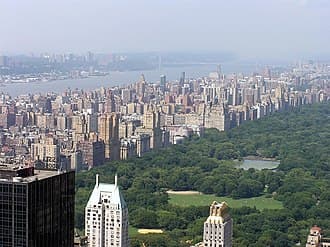

The vibe
The Upper West Side is the Manhattan neighborhood that, decades ago, stopped having a discourse about itself. It just kept being what it was: pre-war apartments on shaded side streets, Broadway lined with bagel shops and the occasional bookshop, Central Park West with its parade of art deco co-ops, and a resident base that's about as close as NYC gets to a stable, multi-generational middle class. The neighborhood is famous for being unfashionable and doing fine without ever having been fashionable. That's not a bug.
Groceries, pharmacies, dry cleaners, schools, gyms, coffee shops, and bus stops are all close. DwellCheck's commute score of 9/10 is above the Manhattan median of 7, reflecting a remarkable transit density: 6 subway stations within the neighborhood, most serving multiple lines, including the 1, 2, 3, B, C. If your definition of a good neighborhood is "a place where you can live well without owning a car and without ever thinking about how you'll get somewhere," this is among the best options in NYC.
The trees are denser than most visitors notice. 353 trees per 200m in NYC Parks' tree inventory and a tree density of 9.9/10 on a citywide percentile scale — the kind of numbers that mean the side streets in the 70s, 80s, and 90s genuinely feel green in summer. Combined with Central Park to the east, Riverside Park to the west, and a scattering of smaller greens and playgrounds in between (Theodore Roosevelt Park, Joan of Arc Park, Lincoln Center's plazas), the UWS is arguably the greenest densely-built neighborhood in Manhattan.
Who actually lives here
The UWS attracts a more diverse resident base than its reputation suggests. DwellCheck's data supports three core personas:
Transit-dependent professionals. Commute score of 9/10 and 6 subway stations with multiple-line redundancy make the neighborhood exceptional for anyone whose job requires frequent movement across the city. The scheduled subway ride is 9–17 minutes to Midtown and 21–29 minutes to the Financial District (MTA subway schedule, GTFS feed of August 26, 2026; weekday midday, including the typical wait but not the walk to the station).
Parents prioritizing schools and outdoor access. Day-to-day family infrastructure is dense, and the school district has historically been one of the most desirable in Manhattan. Central Park and Riverside Park give kids real space to run. The American Museum of Natural History is a rainy-day asset most of the country can't match.
Cultural institution workers and frequent attendees. Lincoln Center — the Metropolitan Opera, the New York Philharmonic, the New York City Ballet, Jazz at Lincoln Center — is embedded in the neighborhood, not adjacent to it. If your life involves going to concerts, opera, or theater often, living within walking distance of the plaza is a quality-of-life multiplier most people underestimate.
What's worth knowing before you sign
"Upper West Side" covers a long stretch. Technically the neighborhood runs from 59th Street up to 110th Street, but it lives as roughly three sub-neighborhoods. The 60s and 70s (Lincoln Square) are polished, expensive, and oriented around Lincoln Center. The 80s and 90s are the classic UWS — pre-war buildings, brownstone side streets, families. The 100s (approaching Morningside Heights) are cheaper, a bit grittier, and more college-adjacent. Where you live inside the neighborhood matters a lot.
Walk-up rows and elevator buildings share the blocks. Of the 3,203 residential tax lots in NYC City Planning's PLUTO, 56% are walk-up apartment buildings, 22% elevator apartment buildings and 7% condominiums. A single elevator building holds far more apartments than a brownstone, so lot shares understate how many people live in elevator buildings — and co-op boards there mean stricter scrutiny if you're buying.
Park proximity is not uniform. The blocks between West End Avenue and Riverside Drive are closest to Riverside Park. The blocks between Central Park West and Columbus are closest to Central Park. Blocks in the middle (Amsterdam, Broadway) are equidistant but further from both. The closest park view is the most expensive — windows that actually look at green carry a large premium.
It's noisier than it looks on some blocks. Per resident, 311 noise complaints here are moderate among the NYC neighborhoods DwellCheck tracks, but Broadway, the major subway hubs, the Lincoln Center area, and the bus routes on Central Park West and Columbus all generate constant ambient urban noise. Side-street apartments facing brownstones are much quieter than avenue-facing units.
💡If you're choosing a UWS block
The 70s between Central Park West and Columbus are the most expensive and most prestigious. The 80s and 90s between West End and Riverside are the best value for families — quieter streets, closer to Riverside Park, and meaningfully cheaper per square foot. The 100s above 96th Street are cheaper still and well-served by the 1, 2, and 3. Avoid anything facing Broadway or Amsterdam directly unless noise doesn't bother you.
The honest downsides
The cost of a real family apartment is brutal. A three-bedroom in a pre-war building with enough square footage for a growing family is expensive to buy or rent. That makes the UWS a neighborhood where family-sized households either bought decades ago or arrive with serious household income.
Noise activity is higher than the vibe suggests. The neighborhood feels calm on paper but carries real acoustic reality. The Broadway corridor, the area around Lincoln Center during performance hours, and the blocks near major subway entrances all carry significant street-level sound. Check the actual apartment, not just the neighborhood.
The small-venue scene is thin. The density of independent cultural venues (galleries, small theaters, independent bookshops, experimental music spaces) is lower than in the East Village or Bushwick. Lincoln Center is a massive institution but doesn't generate small-venue energy. (DwellCheck's ART/livability score, 6.5/10 and above the Manhattan median of 4.7, measures tree density and noise complaints, not venues.)
Getting around
Transit options from the Upper West Side:
- Cathedral Pkwy (110 St) — 1, B, C
- 103 St — 1, B, C
- 96 St — 1, 2, 3, B, C
- 86 St — 1, B, C
- 81 St-Museum of Natural History — B, C
- 79 St — 1
The 1, 2, and 3 run up the west side via Broadway — the 1 is the local (every station), the 2 and 3 are the express (96th, 72nd, and 59th are the key stops). The B and C run under Central Park West and stop at 86th, 81st (Museum of Natural History), and 72nd. The A is the express that runs with them but skips most stations — useful if you're going to Columbus Circle or further south. The D joins at Columbus Circle for travel into Midtown and the Bronx.
Bus service is genuinely useful here in a way it isn't in most NYC neighborhoods — the M10 runs along Central Park West, the M7 and M11 cover Amsterdam and Columbus, and the M5 runs on Riverside Drive. For short hops within the neighborhood, buses are often faster than the subway.
Nearest major parks tracked in DwellCheck's data: Theodore Roosevelt Park, Frederick Douglass Playground, Happy Warrior Playground, Joan Of Arc Park, and others.
Check a specific UWS address
DwellCheck's neighborhood data is aggregate. The full Upper West Side data dashboard — dimension scores, crime data, 311 complaints, building-level data — is free.
See Upper West Side Data Dashboard →Frequently asked questions
1Is the Upper West Side a good place to live?
The Upper West Side scores 7.3/10 on DwellCheck's composite index — #2 of 33 Manhattan neighborhoods scored from NYC Open Data. It's exceptional for transit (9/10) and outdoor space (8.9/10), with Central Park and Riverside Park on opposite sides of the neighborhood. The weaknesses are cost (Manhattan prices for any unit with a view) and a noise profile typical of dense Manhattan.
2What's the vibe in the Upper West Side?
The Upper West Side is the neighborhood that stopped chasing trends decades ago and built an identity around the things that don't go out of fashion: parks, museums, good bookstores, good bagels, and a slower pace than downtown. It's the Manhattan neighborhood most likely to feel like a real neighborhood — people know their doormen, regulars at Zabar's go back decades, and Broadway still has actual storefronts instead of a wall of pharmacies.
3How much does rent cost in the Upper West Side?
Expensive. DwellCheck doesn't track rents, and we don't publish rent figures we can't source; compare live listings for current asking rents. Anything with a Central Park West or Riverside Drive address commands significant premiums. The blocks in the 60s and 70s near Lincoln Center are generally the priciest; the blocks in the 90s and above get more affordable as you approach Morningside Heights.
4Is the Upper West Side safe?
By DwellCheck's count the Upper West Side has a lower crime rate per resident than 81% of Manhattan neighborhoods and a rising crime trend (+5.5%) over the last 12 months, with 5 shooting incidents in NYPD data. Safety varies block by block — check any specific address for walking-radius crime data.
5Is the Upper West Side good for families?
The Upper West Side has been a prototypical family neighborhood for decades, and it still is. Schools, pediatricians, playgrounds, and daily-life infrastructure are all close. Both Central Park and Riverside Park are right there. The American Museum of Natural History is functionally a neighborhood amenity. The downside is cost — family-sized apartments are rare and expensive.
6Is the Upper West Side good for young professionals?
It's workable but unusual. Young professionals who choose the UWS tend to prioritize quiet, parks, and access to Midtown over nightlife and trend density. If you want a walk-to-work-friendly neighborhood where you can actually have a peaceful apartment, it delivers. If you want to be surrounded by bars and restaurants that turn over every year, downtown or Brooklyn will make you happier.
7What's the best part of the Upper West Side?
The park access is genuinely extraordinary. DwellCheck's data lists Theodore Roosevelt Park, Frederick Douglass Playground, Happy Warrior Playground, Joan Of Arc Park, Booker T. Washington Playground among the parks in the neighborhood, with the 3 nearest averaging 341 meters from its center — plus Central Park a block east and Riverside Park a block west of the main residential corridor. Combined with a tree density of 9.9/10 on a citywide percentile scale, this is one of the genuinely green neighborhoods in NYC.
8What's the worst part of the Upper West Side?
The noise realities and the cost. Per resident, the neighborhood's 311 noise complaints are moderate among the NYC neighborhoods DwellCheck tracks, but Lincoln Center, transit hubs, cultural venues, and dense foot traffic make some blocks loud. Apartments facing Broadway or West End Avenue are meaningfully louder than apartments on the side streets. On cost: family-size units have gotten genuinely scarce, and the brownstone blocks between Central Park West and Columbus are very expensive.
9How is the commute from the Upper West Side to Midtown?
Exceptional. Commute score is 9/10 (above the Manhattan median of 7). 6 subway stations inside the neighborhood serve the UWS — Cathedral Pkwy (110 St), 103 St, 96 St, 86 St, 81 St-Museum of Natural History, 79 St — with redundant lines (1, 2, 3, B, C). Scheduled subway time is 9–17 minutes to Midtown and 21–29 minutes to the Financial District from those stations (MTA subway schedule, GTFS feed of August 26, 2026; weekday midday, including the typical wait but not the walk to the station); add the walk to the station.
10What's the food scene in the Upper West Side?
Understated but deep. The UWS doesn't chase Michelin stars or trendy openings, but it has some of the most beloved institutions in the city: Zabar's for appetizing, Barney Greengrass for sturgeon, Café Luxembourg for decades of bistro reliability, Levain for cookies, and a long list of bagel shops, delis, and pre-theater restaurants that actually still work. The new-wave restaurant scene is quieter than downtown but real.
11Is the Upper West Side gentrified or gentrifying?
The UWS gentrified in the 1980s and has stayed gentrified for so long that it has essentially become the baseline. The current conversation is less about gentrification and more about whether it can retain middle-class residents — teachers, professors, journalists — as prices push further out of reach. Many of those residents are rent-stabilized in pre-war buildings and stay decades; their replacements are increasingly only those with significant household income.
12Upper West Side vs Upper East Side — which is better?
They're both excellent and they attract different people. The Upper West Side is more casual, more intellectual-leaning, more park-forward (Central Park + Riverside Park), and has Lincoln Center. The Upper East Side is more polished, has the museum mile (The Met, the Guggenheim, the Frick), and skews more traditional/old-money. Choose based on which side of Central Park matches your life.
The bottom line
The Upper West Side scores 7.3/10 on DwellCheck — #2 of 33 Manhattan neighborhoods scored from NYC Open Data. Its strengths are the ones that matter for long-term living: commute, everyday infrastructure, parks, and a stable residential character. Its weaknesses are the ones that matter for people chasing a scene: it's expensive, moderately noisy, and doesn't generate the small-venue cultural energy of downtown. If your life is about stability, family, museums, and a real neighborhood that will still feel like a neighborhood for years to come, the UWS remains one of the best bets in the city. If you want Manhattan to feel like a nightclub with a view, you're looking in the wrong direction.