Is Bedford Park Safe? Bronx Livability, Crime & Rent
Bedford Park scores 3.7: strong transit is held back by many housing violations and a high crime rate.
For the borough-wide trend and the spread between police precincts, see Is the Bronx safe?

Bedford Park at a glance
- Borough
- Bronx
- Livability score (excludes crime)
- 3.7/10
- Livability rank (NYC Open Data guides)
- #17 of 22
- Safety verdict
- Higher Than Average
- Crimes (12 mo)
- 4,117
- ZIP codes
- 10458 (64%), 10468 (35%)Share of residential units, NYC PLUTO 26v2
- Subway stations
- 3 (Bedford Park Blvd, Kingsbridge Rd, Bedford Park Blvd-Lehman College)
- Data updated
- 2026-09-14
Is Bedford Park Safe?
By NYPD data, Bedford Park is rated "Higher Than Average" for crime, with a lower crime rate per resident than 38% of Bronx neighborhoods (74.2 reported crimes per 1,000 residents). It recorded 4,117 crime incidents and 3 shooting incidents in the 12 months ending June 2026. Bedford Park crime rate and NYPD breakdown →
Bedford Park, Bronx scores 3.7/10 for overall livability, ranking #17 of 22 Bronx neighborhoods scored from NYC Open Data. Bedford Park scores 3.7: strong transit is held back by many housing violations and a high crime rate.
The livability score draws on HPD housing violations, subway access, NYC Parks' tree inventory and parks, and 311 noise complaints per resident from NYC Open Data, refreshed periodically rather than live. It does not include crime; NYPD complaint and shooting figures are on the Bedford Park safety page. Safety varies by block — check a specific Bedford Park address below for a block-level breakdown.
Bedford Park ranks #22 of 37 Bronx neighborhoods for reported crime near a typical spot (1 = fewest)
Mean NYPD complaints (every category) within 300 m of 100 random points in each residential 2020 NTA in the Bronx, 12 months ending June 30, 2026. Each shade holds about a fifth of them. Per area, not per resident, so the order can differ from the per-resident rate.
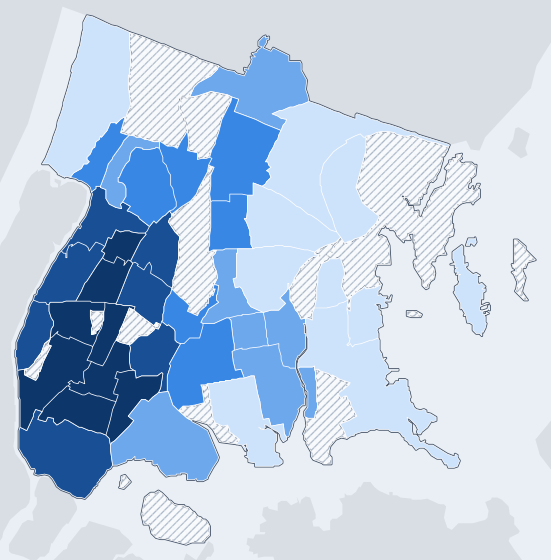
NYPD complaints within 300 m, 12 months to June 30, 2026

Outlined: Bedford Park (BX0702), 508.2, #22. Rape and sex-crime complaints, which NYPD publishes at one point per precinct, are left out. All 37 ranked.
Source: NYPD Complaint Data via NYC Open Data (5uac-w243, qgea-i56i), pulled September 14, 2026; boundaries: 2020 Neighborhood Tabulation Areas (NTAs) (9nt8-h7nd).
Score Overview
Vertical line = borough median. Scale: 0-10.
Practical measures HPD housing violations per residential lot over the last 12 months (higher = fewer violations). Borough medians are computed across DwellCheck's Bronx neighborhood guides.
Neighborhood Character
You'll find Bedford Park characterized by a mix of walk-up and elevator apartments, with 36% of residential tax lots being walk-ups and 22% being elevator apartments. Its tree density is 4.5/10 (city percentile), with an expected 158 trees in a 200m circle. The neighborhood contains five NYC Parks properties, including Harris Park, Jerome Park, and Fort Independence Playground, with Harris Park being the closest at 354m from the center. Transit options include the B and D lines at Bedford Park Blvd, the 4, B, and D lines at Kingsbridge Rd, and the 4 line at Bedford Park Blvd-Lehman College.
Advertisements
Livability & Restoration
Trees
158 trees
Expected in a 200m circle (NYC Parks tree inventory) | Density: 4.5/10 (city percentile)
In Toronto, 10 more trees on a city block went with a rise in self-rated health comparable to being 7 years younger (Kardan et al., 2015, Scientific Reports). In a cross-sectional study of London boroughs, each additional street tree per km of street went with 1.18 fewer antidepressant prescriptions per 1,000 residents (Taylor et al., 2015, Landscape and Urban Planning).
Park Access
5 parks
NYC Parks properties inside the neighborhood | largest: Harris Park | nearest to the center: Harris Park, 354m | 3 nearest average 564m from the neighborhood's center
Acoustic Quality
2/10
Noise proxy score (higher = quieter)
Environmental noise exposure increases the occurrence of hypertension and cardiovascular disease; WHO's night-noise guidelines call average outdoor night noise above 55 dB increasingly dangerous for public health (Basner et al., 2014, The Lancet).
What is the ART Score?
ART stands for Attention Restoration Theory (Kaplan & Kaplan, 1989) — the framework environmental psychologists use to measure whether a place helps your brain recover from mental fatigue, or pushes it deeper into overload. Cities deplete directed attention (the effortful focus you use at work); exposure to restorative environments replenishes it.
DwellCheck uses the idea in two separate places, and they measure different things. The neighborhood ART score below comes from neighborhood-wide data: up to 5 points from tree density (a city percentile) and up to 5 from how few 311 noise complaints there are per resident. An address report has no ART score. It runs the Wellness checks below, and their points go into the address’s overall score.
More than a point below the Bronx median: sparser trees, more noise complaints per resident, or both.
What an address report checks instead (Wellness)
- ±Sensory environment. A calm score minus a busy score, each starting at 50. Busy: a firehouse within 100m (+15) or 200m (+8), and 311 noise complaints within 200m over 6 months (15+ adds 5, 40+ adds 12, 80+ adds 20, and 3 more at 20+ complaints that include vehicle or street noise). Calm: a library (+15), community garden (+12) or public plaza or atrium (POPS; +15 indoor, +8 outdoor) within 200m, and a park within 300m (+10; +15 at 1+ acre; +20 at 5+ acres). A difference of +20 or more adds 8 points; −10 to −29 costs 2; −30 or less costs 4. Bars, museums, tourists and foot traffic are not counted.
- +Third places (Oldenburg, 1989). Public libraries, public plazas and atriums (POPS) and community gardens within 400m: 1–2 add 5 points, 3 or more add 10. Cafés and community centers are not counted. In a meta-analysis of longitudinal studies, loneliness or social isolation went with a 29% higher risk of incident coronary heart disease (Valtorta et al., 2016, Heart).
- 0Street vitality (Jacobs, 1961). Permitted block parties, farmers markets and similar community events in the borough over the past 12 months. The event data has no coordinates, so this is a borough-wide count shown for context. It doesn’t change the score.
Health mechanism. The theory holds that natural settings let directed attention recover. The evidence is mixed: a systematic review of 31 studies (Ohly et al., 2016, Journal of Toxicology and Environmental Health, Part B) found that time in natural environments improved 3 of 13 pooled attention measures (Digit Span Forward, Digit Span Backward and Trail Making Test B) and showed no marked benefit on the other 10.
Theoretical foundations. Kaplan & Kaplan (1989), The Experience of Nature; Jacobs (1961), The Death and Life of Great American Cities; Oldenburg (1989), The Great Good Place.
Bedford Park ranks #33 of 37 Bronx neighborhoods for 311 noise complaints (1 = quietest), with a median of 2 rodent complaints near a typical spot
Median 311 complaints within 100 m (noise) and 150 m (rodents) of 100 random points in each residential 2020 NTA in the Bronx, noise March 13, 2026 to September 13, 2026, rodents March 17, 2026 to September 13, 2026. Noise shades hold about a fifth each; rodent shades break at 1, 2, 4. Complaints filed, not measured sound or a count of rats.
Noise
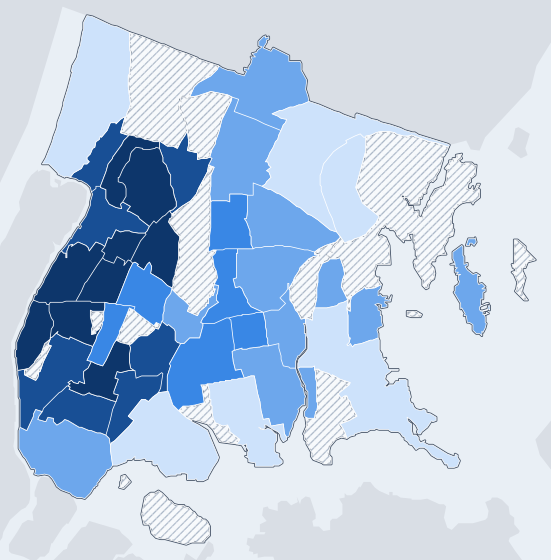
Noise complaints within 100 m (median)

Rodents
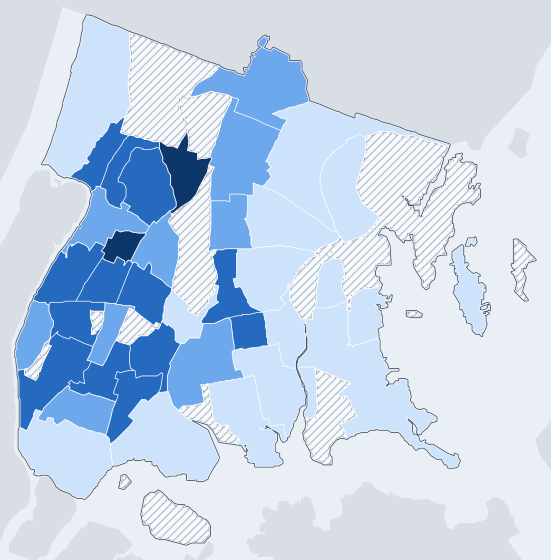
Rodent complaints within 150 m (median)

Outlined: Bedford Park, noise 62.5 (#33), rodents 2. Quietest Bronx neighborhoods.
Source: NYC 311 Service Requests via NYC Open Data (erm2-nwe9), pulled September 14, 2026; boundaries: 2020 Neighborhood Tabulation Areas (NTAs).
Transit & Commute
Subway Stations
Commute Score
6/10
Borough median: 5/10
Where Bedford Park's 3 listed subway stations are
Blue: the stations listed above, at their 4 MTA station complexes. Grey: other subway stations. Outlined: the 2020 NTA this page's figures cover.
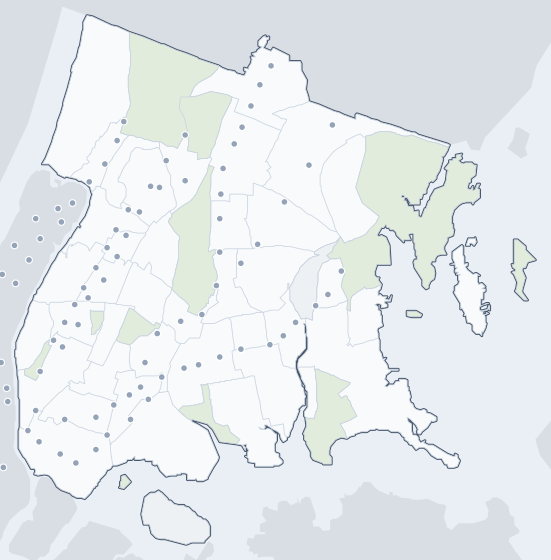
Some names are left off where labels would overlap.
Source: MTA Subway Stations (39hk-dx4f), station complexes at the mean of their stops; boundaries: 2020 Neighborhood Tabulation Areas (NTAs).
Outdoor & Green Space
Avg Tree Count
158
Trees expected in a 200m circle
Tree Density
4.5/10
1,255 trees per km² in NYC Parks' tree inventory (street and park trees); city percentile, 1 = sparsest
Largest Parks In or Near the Neighborhood
- Harris Park
- Jerome Park
- Fort Independence Playground
- Risse Street Park
- Mosholu Playground
Nearest to the neighborhood's center: Harris Park, about 354m. The 3 nearest NYC Parks properties average 564m from the center (approximate park centers, not entrances).

Practical Living
Practical (HPD violations): 2/10 (Bronx median 4). It measures HPD housing violations per residential lot over the last 12 months (higher = fewer violations).
Building Mix (Residential Tax Lots)
Share of the 1,119 residential tax lots in the neighborhood by PLUTO building class (NYC Department of City Planning).
Advertisements
Who Bedford Park Is For
Transit-Oriented Commuters
You'll find a Commute score of 6, above the borough median of 5, supported by multiple subway lines within the neighborhood.
Pre-war Architecture Enthusiasts
You'll find a notable presence of pre-war apartments and community stability, contributing to the neighborhood's established character.
Park Users
You'll find five NYC Parks properties, including Harris Park and Jerome Park, providing outdoor recreation opportunities.
Pros & Cons
Strengths
Strong Commute Score
You'll find a Commute score of 6, above the borough median of 5, with access to Bedford Park Blvd (B,D), Kingsbridge Rd (4,B,D), and Bedford Park Blvd-Lehman College (4) subway stations.
Local Parks Access
You'll find five NYC Parks properties inside the neighborhood, including Harris Park and Jerome Park.
Established Housing Stock
You'll find 36% of residential tax lots are walk-up apartments and 22% are elevator apartments, with existing highlights including pre-war apartments and community stability.
Trade-offs
Lower Livability Score
You'll find an ART/Livability score of 2.8, below the borough median of 3.9.
Higher Crime Rate
You'll find the safety verdict is higher than average (crime per resident against the other tracked Bronx neighborhoods), with a lower crime rate per resident than 38% of Bronx neighborhoods.
High Noise Complaint Rate
You'll find 7727 noise complaints (139.2 per 1,000 residents), labeled High.
Worsening Crime Trend
You'll find a crime trend of worsening (+19.1%) over 12 months.
Lower Practical Score
You'll find a Practical score of 2, below the borough median of 4.
Score Any Address in Bedford Park
Get detailed livability scores based on building health, transit access, safety, noise levels, and 15+ NYC data sources.
Search an Address in Bedford ParkFrequently Asked Questions about Bedford Park
1Is Bedford Park safe?
By NYPD data, Bedford Park is rated "Higher Than Average" for crime, with a lower crime rate per resident than 38% of Bronx neighborhoods (74.2 reported crimes per 1,000 residents). It recorded 4,117 crime incidents and 3 shooting incidents in the 12 months ending June 2026. See the safety page for the full breakdown.
2What is the average rent in Bedford Park?
Rents in Bedford Park, Bronx vary significantly by building and apartment type. Market pricing isn't aggregated for this neighborhood yet; use DwellCheck to research specific addresses for HPD registration, HPD violations, and other building-level records. DwellCheck doesn't show rent-stabilization status; request the apartment's rent history from DHCR for that.
3How is transit access in Bedford Park?
Bedford Park has a commute score of 6/10. 3 subway stations serve the area: Bedford Park Blvd, Kingsbridge Rd, Bedford Park Blvd-Lehman College.
4What are the best streets in Bedford Park?
The best streets depend on your priorities. Use DwellCheck to compare specific addresses across livability, safety, transit, and environmental factors.
5What is Bedford Park known for?
Bedford Park sits in Bronx and ranks #17 of 22 Bronx neighborhoods scored from NYC Open Data on DwellCheck's livability score (3.7/10). It's served by 3 subway stations (Bedford Park Blvd, Kingsbridge Rd, Bedford Park Blvd-Lehman College). Bedford Park scores 3.7: strong transit is held back by many housing violations and a high crime rate.
6What is it like to live in Bedford Park?
DwellCheck scores Bedford Park, Bronx from NYC Open Data on practical (HPD housing violations per residential lot over the last 12 months (higher = fewer violations)), commute (subway stations and lines in the neighborhood), ART (tree density and 311 noise complaints per resident), outdoor (trees and park proximity). Bedford Park's composite is 3.7/10. Bedford Park scores 3.7: strong transit is held back by many housing violations and a high crime rate. For the block-by-block view, run any specific Bedford Park address through DwellCheck.
7Where is Bedford Park?
Bedford Park is in the Bronx, New York City. DwellCheck maps it to the Bedford Park Neighborhood Tabulation Area (BX0702), which falls in the Census tabulation area that approximates Bronx Community District 7 (Fordham-Bedford Park-Norwood). Its main ZIP codes are 10458 and 10468. Subway stations in the neighborhood include Bedford Park Blvd, Kingsbridge Rd and Bedford Park Blvd-Lehman College.
8What ZIP code is Bedford Park in?
Bedford Park spans ZIP codes 10458 (64% of residential units) and 10468 (35%). Shares are of the 23,673 residential units in the Bedford Park Neighborhood Tabulation Area (BX0702), from NYC PLUTO 26v2 tax-lot records. 1 other ZIP code holds under 5%.
9Can you walk around Bedford Park at night?
Bedford Park is classified as "Higher Than Average" by NYPD complaint data. Over the past 12 months it recorded 3 shooting incidents and 4,117 total crime incidents. Walking at night carries the same risk profile as anywhere in NYC: stay on commercial corridors with foot traffic, avoid empty side streets after midnight, and prefer subway lines that run 24/7.
10Is Bedford Park dangerous?
By NYPD data, Bedford Park is rated "Higher Than Average", with a lower crime rate per resident than 38% of Bronx neighborhoods. 4,117 crime incidents over 12 months. Block-level risk varies; check the address-level safety score for any specific street or building.
11What parts of Bedford Park should I avoid?
NYPD complaint records carry approximate incident coordinates, but a neighborhood total can't tell you which blocks drive it, so we don't publish an "avoid this street" list. For a specific block, use DwellCheck's address-level safety score, which counts NYPD crime complaints within a 300m radius of the building over the latest 12 months of published data and compares that count with the borough average.
12Is Bedford Park a good place to live?
Bedford Park scores 3.7/10 for overall livability and has a lower crime rate per resident than 38% of Bronx neighborhoods. Bedford Park scores 3.7: strong transit is held back by many housing violations and a high crime rate. Whether it's a good fit depends on what you weight: families, solo renters, and remote workers each prioritize different factors (noise, transit access, parks, building quality).
13What is the average DwellScore in Bedford Park?
You'll find the DwellCheck Composite Score for Bedford Park is 3.7, influenced by its Commute score of 6 and ART/Livability score of 2.8.
14How does Bedford Park compare in terms of safety?
You'll find Bedford Park has a safety verdict of higher than average crime per resident against other tracked Bronx neighborhoods, with a lower crime rate per resident than 38% of Bronx neighborhoods, and a worsening crime trend of +19.1% over 12 months.
15What are the transit options in Bedford Park?
You'll find transit at Bedford Park Blvd (B,D), Kingsbridge Rd (4,B,D), and Bedford Park Blvd-Lehman College (4).
16What is the tree density in Bedford Park?
You'll find a tree density of 4.5/10 (city percentile), with 158 expected trees in a 200m circle.
17What type of housing will I find in Bedford Park?
You'll find that 36% of residential tax lots are walk-up apartments, 22% are two-family, and 22% are elevator apartments.
Related Guides
NYC Building Complaints Lookup
Check any building's HPD, DOB, and 311 complaint history before signing.
30 NYC Apartment Red Flags
What to watch for at the viewing, in the listing, and on the landlord.
How to Check Your NYC Landlord
A 5-step free lookup: ACRIS ownership, HPD violations, DOB complaints, lawsuits.
Is My Apartment Rent-Stabilized?
Request a free DHCR rent history and verify stabilization status in 24-72 hours.