Is Park Slope, Brooklyn Safe? Crime Rate & NYPD Data (2026)
Park Slope has a lower crime rate per resident than 47% of Brooklyn neighborhoods, or 48.9 reported crimes per 1,000 residents. Measured per resident, it sits on the higher-crime half of Brooklyn. DwellCheck rates it "Average" — typical for the borough — from 2,806 NYPD complaint records and 2 shooting incidents over the 12 months ending June 2026, and incidents are up 14.3% year-over-year. Safety varies block by block, so read this as neighborhood context rather than a verdict on any single street.
Over the same 12 months, 311 logged 5,615 quality-of-life complaints in Park Slope. Park Slope is considered about average, with a lower crime rate per resident than 47% of Brooklyn neighborhoods. Incidents are trending up with 2,806 total incidents recorded over the past 12 months.
Data covers June 2025 – June 2026 (12 months) · Source: NYPD Complaint, Shooting & Arrest Data and NYC 311 via NYC Open Data · Updated September 14, 2026
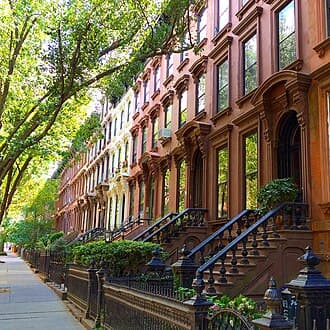
What Is the Crime Rate in Park Slope?
Park Slope recorded 2,806 NYPD crime complaints over the 12 months ending June 2026. Against the 2020 Census population of its Neighborhood Tabulation Areas (57,405 residents) that is 48.9 reported crimes per 1,000 residents, which is a lower crime rate per resident than 47% of Brooklyn neighborhoods. Of those, 627 were felonies and 121 were violent crimes (murder, rape, robbery or felony assault). Crimes are counted where they were reported, so commercial and nightlife blocks push the rate up in districts with few residents.
Park Slope Safety Dashboard
Total Crime Incidents
2,806
Past 12 months · 48.9 per 1,000 residents
Shooting Incidents
2
Past 12 months
Violent Crimes
121
Murder, rape, robbery, felony assault
Year-over-Year Trend
↑ 14.3%
14.3% more incidents
* Borough rate: the borough's count per resident across the neighborhoods we track, applied to this neighborhood's 57,405 residents (2020 Census).
Most Common Crimes in Park Slope
Most Common Crime Types
| Type | Count | % of Total |
|---|---|---|
| petit larceny | 419 | 14.9% |
| administrative code | 344 | 12.3% |
| harrassment 2 | 286 | 10.2% |
| other offenses related to theft | 269 | 9.6% |
| offenses against public admini | 178 | 6.3% |
| grand larceny | 177 | 6.3% |
| assault 3 & related offenses | 147 | 5.2% |
| criminal mischief & related of | 138 | 4.9% |
Severity Distribution
Where Crimes Occur

Quality of Life Indicators
311 complaints reveal patterns about daily quality of life that crime statistics alone do not capture. These are resident-reported issues from the past 12 months. Rates use the 2020 Census population (57,405 residents). Labels compare each rate with the other NYC neighborhoods we track: Low is the bottom quarter, Moderate the middle half, High the next 15%, and Very High the top 10%.
Noise Complaints
2,924
50.9 per 1,000 residents
Moderate
Rodent Reports
240
4.2 per 1,000 residents
High
Sanitation Issues
531
9.3 per 1,000 residents
Moderate
Heat/Hot Water
1,920
33.4 per 1,000 residents
Moderate
Arrest Activity
Arrest data reflects law enforcement activity in the area. High arrest counts relative to crime can indicate active policing; low counts may reflect under-enforcement or lower crime.
Total Arrests
1,750
Past 12 months
Felony Arrests
498
28% of total
Misdemeanor Arrests
967
55% of total
How Safe Is Park Slope Compared to Other Brooklyn Neighborhoods?
Brooklyn Neighborhood Safety Comparison
| Neighborhood | Crime Incidents | Per 1,000 Residents | Shootings | Verdict | Percentile |
|---|---|---|---|---|---|
| Borough Park | 1,399 | 14.9 | 1 | Much Safer Than Average | 100% |
| Windsor Terrace | 384 | 16.3 | 0 | Exceptionally Safe | 97% |
| Kensington | 1,048 | 25.1 | 0 | Exceptionally Safe | 94% |
| Dyker Heights | 1,206 | 25.8 | 0 | Exceptionally Safe | 92% |
| Midwood | 1,489 | 28.2 | 1 | Much Safer Than Average | 89% |
| Bensonhurst | 3,309 | 31.5 | 1 | Much Safer Than Average | 86% |
| Gravesend | 4,874 | 33.9 | 6 | Higher Than Average | 83% |
| Prospect Heights | 816 | 34.7 | 1 | Much Safer Than Average | 81% |
| Sheepshead Bay | 2,435 | 35.2 | 7 | Higher Than Average | 78% |
| Brooklyn Heights | 909 | 36.2 | 0 | Much Safer Than Average | 75% |
| Bay Ridge | 3,279 | 37.8 | 0 | Safer Than Average | 72% |
| Ditmas Park | 1,633 | 38 | 1 | Safer Than Average | 69% |
| Marine Park | 1,875 | 39.9 | 0 | Safer Than Average | 67% |
| Clinton Hill | 1,149 | 40.1 | 1 | Safer Than Average | 64% |
| Brighton Beach | 1,400 | 41.7 | 0 | Safer Than Average | 61% |
| Greenpoint | 1,714 | 44 | 0 | Safer Than Average | 58% |
| Bath Beach | 1,598 | 48.3 | 0 | Safer Than Average | 56% |
| Canarsie | 4,361 | 48.5 | 4 | Average | 53% |
| Flatlands | 3,268 | 48.7 | 3 | Average | 50% |
| Park Slope (this page) | 2,806 | 48.9 | 2 | Average | 47% |
| Cypress Hills | 2,378 | 55 | 9 | Higher Than Average | 44% |
| Williamsburg | 3,619 | 56.2 | 2 | Higher Than Average | 42% |
| Prospect Lefferts Gardens | 3,093 | 62.5 | 5 | Higher Than Average | 39% |
| Flatbush | 4,256 | 64 | 7 | Higher Than Average | 36% |
| Carroll Gardens | 3,893 | 65.8 | 5 | Higher Than Average | 33% |
| Sunset Park | 3,719 | 68.3 | 8 | Higher Than Average | 31% |
| Bushwick | 8,494 | 70.3 | 6 | Higher Than Average | 28% |
| East Flatbush | 11,757 | 71.7 | 19 | Higher Than Average | 25% |
| Crown Heights | 9,905 | 72.9 | 22 | Much Higher Than Average | 22% |
| Bed-Stuy | 13,309 | 76.6 | 24 | Much Higher Than Average | 19% |
| Fort Greene | 3,170 | 96.2 | 3 | Much Higher Than Average | 17% |
| East New York | 14,110 | 99.8 | 28 | Much Higher Than Average | 14% |
| Starrett City | 1,749 | 102.7 | 3 | Much Higher Than Average | 11% |
| Coney Island | 5,510 | 111.3 | 9 | High Activity Area | 8% |
| Brownsville | 7,041 | 116.4 | 17 | High Activity Area | 6% |
| Ocean Hill | 4,506 | 118.7 | 10 | High Activity Area | 3% |
| Downtown Brooklyn | 6,502 | 158.7 | 4 | High Activity Area | 0% |

Understanding This Data
All crime statistics on this page come from NYPD Complaint Data, Shooting Incident Data and Arrest Data published on NYC Open Data, refreshed periodically. Incidents are mapped to neighborhood boundaries using the NYC Department of City Planning Neighborhood Tabulation Areas (NTAs) — the same geographic units used in official census reporting. Each safety score reflects the cumulative activity within the NTA boundaries assigned to Park Slope.
NTA boundaries are drawn to maintain population comparability across census tracts, which means they may not perfectly align with what residents consider their "neighborhood." In some cases, a single NTA spans areas with different character. The percentile ranking compares Park Slope's reported crimes per resident (its NTAs' 2020 Census population, 57,405) only against the other neighborhoods we track in Brooklyn, so it is borough-relative rather than city-wide. Crimes are counted where they were reported, so commercial and nightlife districts with few residents rank high. The borough averages on this page apply the borough's crimes per resident to Park Slope's population.
Safety conditions vary significantly block by block. Neighborhood-level statistics provide important context but should not substitute for address-level research. Use DwellCheck to analyze a specific address and understand the precise safety environment within walking distance of where you plan to live.
Frequently Asked Questions about Park Slope Safety
Is Park Slope safe?
Park Slope has a lower crime rate per resident than 47% of Brooklyn neighborhoods, or 48.9 reported crimes per 1,000 residents. Measured per resident, it sits on the higher-crime half of Brooklyn. DwellCheck rates it "Average" — typical for the borough — from 2,806 NYPD complaint records and 2 shooting incidents over the 12 months ending June 2026, and incidents are up 14.3% year-over-year. Safety varies block by block, so read this as neighborhood context rather than a verdict on any single street.
What is the crime rate in Park Slope?
Park Slope recorded 2,806 NYPD crime complaints over the 12 months ending June 2026. Against the 2020 Census population of its Neighborhood Tabulation Areas (57,405 residents) that is 48.9 reported crimes per 1,000 residents, which is a lower crime rate per resident than 47% of Brooklyn neighborhoods. Of those, 627 were felonies and 121 were violent crimes (murder, rape, robbery or felony assault). Crimes are counted where they were reported, so commercial and nightlife blocks push the rate up in districts with few residents.
What are the most common crimes in Park Slope?
The most common crimes in Park Slope are: 1. PETIT LARCENY (419 incidents, 14.9% of total); 2. ADMINISTRATIVE CODE (344 incidents, 12.3% of total); 3. HARRASSMENT 2 (286 incidents, 10.2% of total).
Is Park Slope safer than the Brooklyn average?
Park Slope has a lower crime rate per resident than 47% of Brooklyn neighborhoods. It had 19% fewer incidents than the borough average (2,806 vs. a borough average of 3,449 for a neighborhood of the same population, 57,405 residents in the 2020 Census). That is 48.9 reported crimes per 1,000 residents.
How has crime changed in Park Slope?
Crime in Park Slope has worsened by 14.3% year-over-year, rising from 2,454 to 2,806 incidents. The trend is classified as "worsening."
What do 311 complaints say about Park Slope?
Over the past 12 months, 311 recorded 2,924 noise complaints (moderate per resident), 240 rodent complaints (high) and 531 sanitation complaints (moderate). Each label compares the rate per resident (2020 Census) with the other NYC neighborhoods we track. These quality-of-life indicators provide context beyond crime statistics.
Is Park Slope safe at night?
Night safety in Park Slope varies by block. About 20.7% of crimes occur on streets and sidewalks. Park Slope recorded 2 shooting incidents in the past 12 months. Use DwellCheck to research specific addresses and understand block-by-block conditions.
Is Park Slope safe for families?
For families considering Park Slope: the neighborhood recorded 2,924 noise complaints (moderate per resident among the NYC neighborhoods we track) and 240 rodent reports. It has a lower crime rate per resident than 47% of Brooklyn neighborhoods. Family-friendliness also depends on schools, parks, and building quality — use DwellCheck to evaluate a specific address.
What is the safest neighborhood in Brooklyn?
Safety varies across Brooklyn neighborhoods. Park Slope has a lower crime rate per resident than 47% of Brooklyn neighborhoods, with 2,806 incidents. Compare all Brooklyn neighborhoods in the comparison table above to see each one's crimes per 1,000 residents, shootings, and borough percentile. Crime data is NYPD Complaint Data via NYC Open Data.
Can you walk around Park Slope at night?
Park Slope is classified as "Average" by NYPD complaint data. Over the past 12 months it recorded 2 shooting incidents and 2,806 total crime incidents — 19% fewer incidents than the borough average. Walking at night carries the same risk profile as anywhere in NYC: stay on commercial corridors with foot traffic, avoid empty side streets after midnight, and prefer subway lines that run 24/7.
Is Park Slope dangerous?
By NYPD data, Park Slope is rated "Average", with a lower crime rate per resident than 47% of Brooklyn neighborhoods. 2,806 crime incidents over 12 months, worsened by 14.3% year-over-year, rising from 2,454 to 2,806 incidents. Block-level risk varies; check our address-level safety score for any specific street or building, which counts NYPD complaints within a 300-meter radius.
What parts of Park Slope should I avoid?
NYPD complaint records carry approximate incident coordinates, but a neighborhood total can't tell you which blocks drive it, so we don't publish an "avoid this street" list. For a specific block, use DwellCheck's address-level safety score, which counts NYPD complaint records within a 300m radius of a specific building. As a general rule across all NYC neighborhoods: industrial blocks with no foot traffic are higher-risk than residential blocks; subway-station-adjacent commercial corridors are lowest-risk.
Is Park Slope a good place to live?
Park Slope is considered about average, with a lower crime rate per resident than 47% of Brooklyn neighborhoods. Incidents are trending up with 2,806 total incidents recorded over the past 12 months. Whether it's a good fit depends on what you weight: families, solo renters, and remote workers prioritize different factors (noise, transit access, parks, building quality). Use DwellCheck's full livability page for Park Slope to see all six dimensions side-by-side.
Check a Specific Address in Park Slope
Neighborhood statistics tell part of the story. Get address-level crime data, building health scores, and transit access for any specific location in Park Slope.
Search an Address in Park SlopeCompare Park Slope with Nearby Brooklyn Crime Rates
The Brooklyn neighborhoods whose crime rate per resident is closest to Park Slope's.